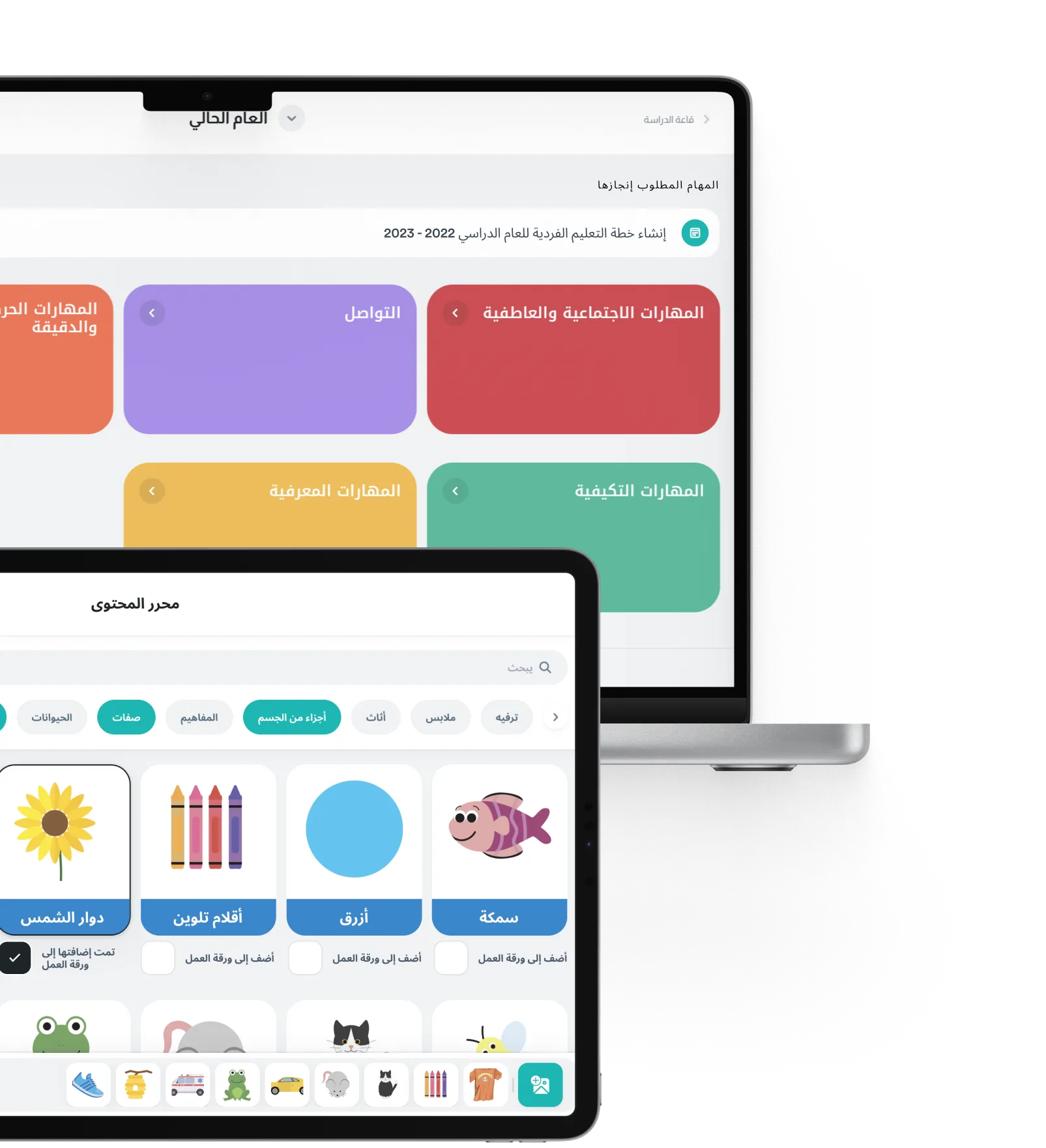
SAUT is a school in Riyadh for children with Down syndrome, with a board chaired by HRH Princess Rima bint Sultan bin Abdulaziz Al Saud. The platform I built — also called SAUT — is a Learning Management System designed for their teachers: a tool for planning individualised curricula, running daily assessments, printing personalised learning materials, and tracking each child's progress across years of education.
The students never touch the software. Everything is in-person — flash cards on the table, worksheets on paper, assessments done face to face. The platform exists to help teachers do that work better: to know what each child has mastered, what they've forgotten, what to teach next. The technology serves the pedagogy, not the other way around.
I was on this project from day one to handoff — four-plus years. I worked on both versions of the frontend, managed the product roadmap, designed screens when the design team couldn't keep up, and helped ship all six release phases. It's the longest I've worked on any single product, and the one whose early decisions I lived with longest.
The complexity
The data model alone would give you pause. A curriculum in SAUT has five levels of nesting: Curriculum → Domain → Category → Goal → Subgoal. Each subgoal carries its own assessment criteria, flashcards, lesson plans, and learning materials. Multiply that across every student, every classroom, every academic year.
Then there's assessment. Four different criteria types — a linear 5-point scale for most domains, binary pass/fail for others, an 8-point Makaton scale for signed communication, and percentile-based scoring for early childhood. A subgoal is "complete" when a student hits a success threshold: say, three successful assessments out of five attempts, not necessarily consecutive. The system tracks all of this automatically.
The Scale
What the system had to handle.
Nine user roles, each with a different slice of the system. A teacher creates IEPs (individualised education plans) and runs daily assessments. A supervisor reviews and approves them before they're finalised. A speech therapist only sees communication-related goals. The school admin manages staff but can't create IEPs. The super admin controls the curriculum across multiple schools. Every action in the system passes through an approval workflow — teacher creates, supervisor reviews, teacher finalises. The permission matrix had 66 rows.
V1 — the first build
V1 was built with Vue.js on the frontend and Ruby on Rails on the backend. I joined at Able.do (then called Uncommon) and this was one of my first major projects. For V1, I was 100% frontend — writing Vue components, building the assessment interfaces, the student profiles, the IEP creation flows. My colleague Surajith handled the functional plumbing; I took on the complex UI, the page animations, and the RTL work.
V1 worked. Teachers used it daily. Students were assessed, IEPs were created, reports were generated. But there was a fundamental architectural problem hiding under the surface, and it was getting worse with every school that adopted the system.
The duplication problem
In V1, when a teacher created an IEP for a student, the system copied goals and subgoals from the curriculum into the student's record. Every student got their own duplicate of every goal they were working on. If someone found a typo in the master curriculum, or restructured a category, or updated assessment criteria — none of those changes reached existing IEPs. You'd have to manually update every student's copy.
At one school, that was manageable. When the plan was to scale to multiple schools sharing the same curriculum, it was a time bomb. Imagine correcting a subgoal description and having to propagate that change across hundreds of student records across multiple institutions. It couldn't work.
The decision was made: complete rewrite. Not a refactor, not an incremental migration — a clean rebuild of the frontend and a restructuring of the backend data model. Central curriculum database with linked references instead of copies. Updates propagate automatically. No duplication.
The frontend went too, for a different reason. Teachers ran SAUT as a PWA on their tablets and iPads, and the Vue bundle had grown heavy for those devices. SvelteKit was new in the market, but it compiles components away instead of shipping a runtime — a lighter app on the hardware teachers actually carried. Since the data layer was being rebuilt anyway, it was the moment to change frameworks rather than carry the weight into V2.
V2 — the rewrite
We migrated the frontend from Vue.js to SvelteKit and restructured the Rails backend to support the new linked-reference architecture. The timeline was aggressive: kickoff in March 2023, beta by July 15, final release by August 1. Five months for a complete rewrite of a production system that teachers depended on daily.
The Migration
What changed between V1 and V2.
The team was small: two frontend developers, one backend developer. No dedicated QA — we tested everything ourselves. I handled the complex UI work: the assessment interfaces, the curriculum browser, the student onboarding flows, all the page animations, and the entire RTL/LTR system. Surajith focused on the functional side — data fetching, state management, form handling.
We migrated all active student data, all curriculum content, all historical assessments and IEPs. Teachers had to log in to a new interface in August and keep working without missing a beat. The school year waits for no one.
Product demo — Student onboarding & IEP creation
Initial assessment → competency check → semester curriculum creation
The RTL challenge
SAUT is a bilingual application. The interface runs in both Arabic (right-to-left) and English
(left-to-right), with a toggle that switches the entire UI live. This isn't just flipping direction: rtl on the body — it's every layout, every animation, every interaction.
Scroll animations that slide content in from the left? They need to slide from the right in RTL.
A sidebar that opens from the left edge? It opens from the right. Progress bars that fill
left-to-right? Reversed. Tab navigation, breadcrumbs, icon positions, text truncation,
number formatting — everything mirrors. The dir attribute on the body sets the
direction, and Tailwind's rtl: and ltr: variants carry most of the rest —
over a thousand of them across the codebase, from reversed spacing to icons rotated 180°. The
sliding tab indicator needed hand-written mirrored transforms. The edge cases are endless.
The curriculum content itself is in Arabic — domain names, goal descriptions, subgoal titles, flashcard labels. But the UI chrome, navigation, and structural elements needed to work in both directions. Teachers could switch languages without reloading, and the layout had to respond instantly.
Offline in the classroom
Classrooms don't always have a connection, and teachers ran SAUT as a PWA on their tablets. A Workbox service worker caches pages and API reads. When a teacher marks attendance or a daily assessment offline, the record goes into IndexedDB (through Dexie) instead of the API. When the connection returns, the Background Sync API replays the queue: each record is posted to the backend and deleted locally only once the server has accepted it, and the teacher gets a notification with the count.
Product demo — Daily classroom assessment
Teacher marks each student's progress on their assigned subgoals — all done in person
The roadmap
V2 wasn't a single release — it was a 65-feature roadmap phased across six versions. Phase 2.0 was the core: login, student onboarding, IEP creation and daily assessment. Each subsequent phase added a layer: materials library, case studies, worksheets, classgroups, reports at three levels (student, classroom, school), and finally a digital curriculum module for parents to subscribe to individually.
All six phases shipped. Every feature on the roadmap made it to production. For a three-person dev team working with daily client calls and no dedicated QA, that's the thing I keep coming back to. Not any single feature, but the fact that we planned sixty-five of them and delivered all sixty-five.
The team and the client
The design came from Tropics, an external design studio led by Zubin. They created the visual language and the Figma files. The client team at SAUT — led by Haifa Alshaik — handled UAT and provided daily feedback.
We had daily calls. Not weekly check-ins — daily. The SAUT team would test new features, report issues, discuss improvements, and we'd plan the next steps together. That rhythm is what made the aggressive timeline possible. There was never a gap longer than a day between a question and an answer.
The stack
- Frontend: SvelteKit + Tailwind CSS (V2), Vue.js (V1)
- Backend: Ruby on Rails + PostgreSQL
- Hosting: AWS Middle East region — $200–300/month operational cost
- Security: Cloudflare — WAF, SSL/TLS, rate limiting, DDoS protection
- Offline: Workbox service worker, Dexie (IndexedDB) queue, Background Sync for attendance and assessments
- Testing: RSpec (backend), Vitest + Playwright (frontend)
- Design: Figma — three files maintained by Tropics
The handoff
After four-plus years, the contract moved to a larger company based in the Middle East. As the project grew, the stakeholders wanted a regional team with a bigger name for investor visibility. It wasn't a performance decision — every phase had shipped, the product was stable, and the teachers were using it daily.
We handed off a documented, tested system with a complete product wiki, permission matrices, data migration guides, and operational runbooks. The kind of handoff where the receiving team can actually pick it up and keep going.
What I learned
- A three-person team can ship a complex product if the communication loop is tight enough. Daily calls with the client removed ambiguity faster than any specification document.
- Data architecture decisions made in year one define what's possible in year four. V1's copy-based model held while there was one school, and stopped holding the moment there were two — a five-month rewrite.
- RTL support isn't a feature you bolt on at the end. It's an architectural decision that shapes every component, every animation, every layout decision from day one.
- Building the same product twice — first in Vue, then in Svelte — teaches you what the framework gave you and what was always just your code. Most of the hard problems were domain problems, not framework problems.
- The best product knowledge comes from building every screen yourself. By V2, I could answer product questions faster than checking the spec because I'd already built the flows that the spec described.
More on SAUT
Deep dives into specific aspects of the project.
the next chapter
6 min · 2023
The Worksheet Builder — A Design Tool Inside an LMS
Deep Dive · SAUT